
The short answer
Ceiling wallpaper adds pattern overhead and suits dining rooms, powder rooms, bedrooms and tray ceilings. We repair and prime the surface, lay out strips along the room's main sight line, hang them from scaffolding, and trim neatly at walls and light fixtures.
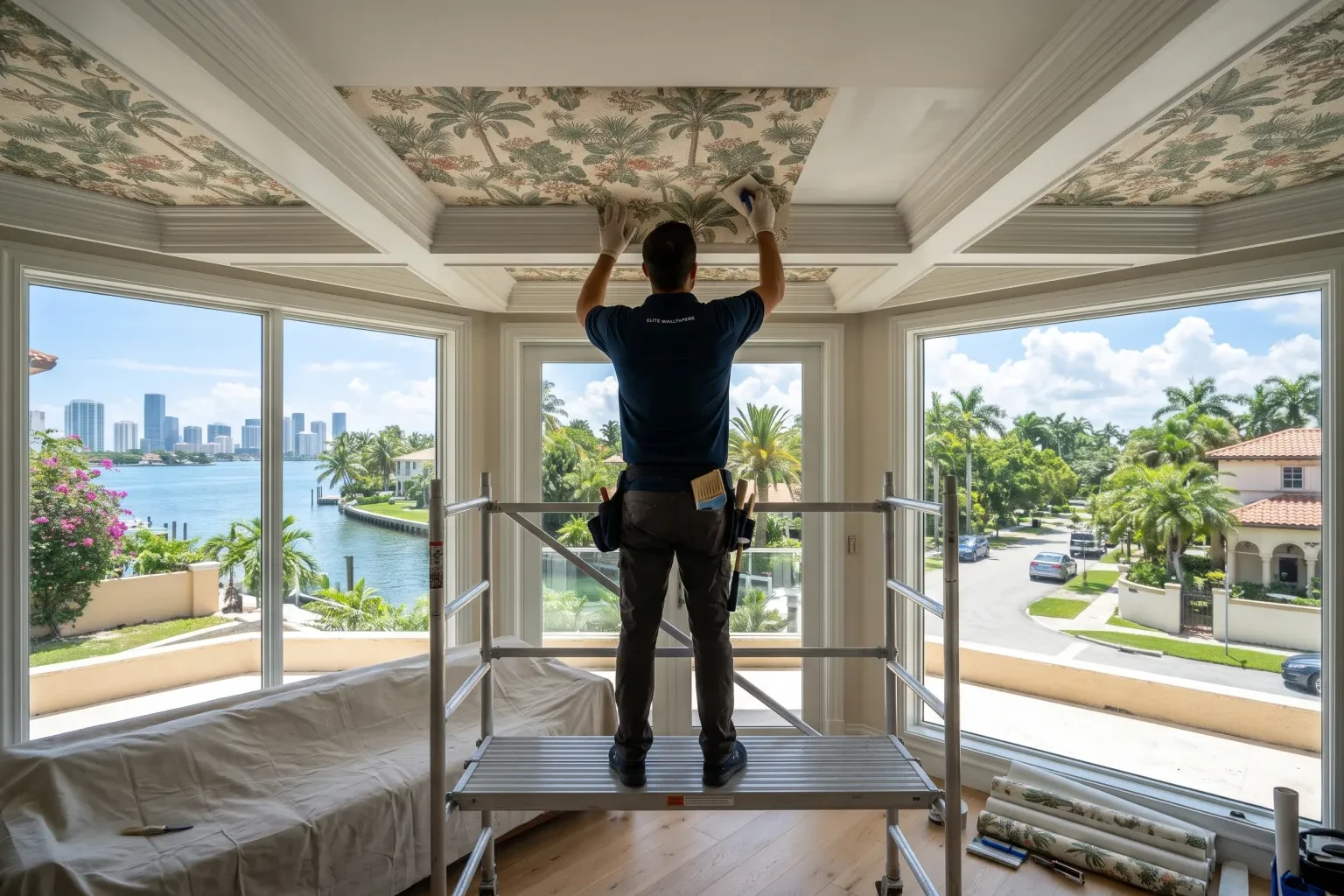
Ceilings are sometimes called the fifth wall, and in a lot of Miami houses they are the largest blank surface in the room. Papering one overhead adds color and texture where nobody expects it, and it can make a tall space feel more intimate or a low one feel finished. It is also one of the most physically demanding jobs in our trade: the paper has to be held above your head while it is aligned, smoothed and trimmed, and gravity works against every strip. Our crew at WallStyle Installers sets up proper platforms, plans the layout from the room's sight lines, and hangs ceilings in bedrooms, dining rooms, powder rooms and covered porches around Miami. Below you will find how we decide whether a ceiling is suitable, how it is prepared, the order we hang in, what drives the scope, and how to look after it.
Rooms where a papered ceiling earns its place
Small rooms are the easiest win. A powder room with a patterned ceiling feels like a jewel box, and because there is so little floor area the job is manageable. Dining rooms are another favorite, since people sit and look up while they talk, and a chandelier medallion gives the pattern a natural center.
Tray and coffered ceilings, which show up in many newer houses in Kendall, Doral and Coral Gables, are a natural frame. Papering only the recessed center panel highlights the architecture without overwhelming the room. Bedrooms work well too, especially with soft textures or small repeating prints that you see from the pillow.
We tend to steer people away from ceilings in full bathrooms without a strong exhaust fan, kitchens over the cooktop, and any ceiling with a history of roof leaks. Popcorn texture also has to come off first, and in older homes we recommend having it tested before scraping, because some textures from past decades contained asbestos.
- Strong fits: powder rooms, dining rooms, tray ceiling centers, bedrooms, home offices, enclosed lanais that are air conditioned
- Use caution: steamy bathrooms, kitchens, ceilings with water stains or recent leaks
- Prep first: popcorn or heavy knockdown ceilings
Prep work above your head
Ceilings collect problems that walls do not. Drywall seams sag a little, nail pops appear as the house moves, and a summer of thunderstorms can leave faint water marks if a roof or AC drain has ever leaked. We check every one of those before anything else, and if a stain is fresh we ask you to have the source fixed first.
Any texture gets removed or skimmed, nail pops are reset and covered, and cracked tape joints are recoated and sanded. Light fixtures and ceiling fans are taken down with the breaker off, and the electrical boxes are capped safely so we can paper right up to them.
We then roll on a wallpaper primer. On a ceiling, primer does extra duty: it gives the paste better initial grab so the strip stays up while we work it into place, and it keeps the paper from absorbing paste unevenly and bubbling later. The primer has to dry fully before hanging begins, which is one reason ceiling work often spans more than a day.
The order of work on a ceiling
The direction of the strips is the first big decision. We usually run them parallel to the longest wall or along the line you see from the doorway, so seams point toward the viewer instead of across the eye. If there is a central fixture, we position the pattern so the motif is balanced around it.
Next comes measuring. We record the length and width of the ceiling, the location of fixtures and vents, and the pattern repeat. Because ceilings are almost never perfectly square to the walls, we snap a straight reference line a strip's width from one wall instead of trusting the wall itself.
Strips are cut long enough to run a few inches down each wall or past the crown molding. Each new strip is matched against the previous one on the table before it is cut, so the repeat flows across the whole surface without a visible jump.
For hanging, the pasted strip is folded accordion style so one person can carry it up a scaffold plank and release it a section at a time. We align the first fold to the reference line, brush it up, unfold the next section and keep going across the room. A second installer often supports the loose length with a clean roller or broom.
Seams are butted tight and rolled gently. The last step is trimming where the ceiling meets the walls or the crown molding, cutting around fixture boxes, and wiping paste from the surface. Then fixtures go back up once the paper has had time to grab.
Factors that shape the estimate
Ceiling work involves more setup than wall work, so a few variables carry extra weight.
- Surface condition, including texture removal, crack repair and nail pops
- Ceiling height, since a standard bedroom needs planks and ladders while a vaulted living room may need rolling scaffolding
- Room size and shape, with tray, coffered or sloped sections taking longer than a flat rectangle
- Paper weight and type: lightweight non-woven papers are easier overhead than heavy vinyls or delicate natural fibers
- Pattern repeat, because large repeats waste more paper and need careful alignment around a center point
- The number of fixtures, fans, vents and recessed lights that need cutouts
- Furniture moving and floor protection
Keeping a ceiling paper in good shape
Ceilings see far less wear than walls, so care is simple. Dust occasionally with a long-handled soft duster or a vacuum brush; cobwebs come off easily that way. Avoid spraying cleaners upward. If something does mark the paper, follow the cleaning guidance printed with your roll.
Watch the paper as a sort of early warning system. A new brown ring or a bubble near a corner can mean a roof, plumbing or AC drain problem above, especially after heavy rain or a tropical storm between June and November. Have the leak checked first, then call us to repair or replace the affected strips.
Running the AC steadily and using bathroom exhaust fans keeps humidity in check, which protects the seams for the long run. Save a spare roll from the same batch so any future patch matches.